 Created in 2007 by the Pennsylvania Office of Child Development and Early Learning (OCDEL), The Pennsylvania Key implements the work and supports the policies developed and managed by OCDEL. Learn More. >
Created in 2007 by the Pennsylvania Office of Child Development and Early Learning (OCDEL), The Pennsylvania Key implements the work and supports the policies developed and managed by OCDEL. Learn More. >
Created in 2007 by the Pennsylvania Office of Child Development and Early Learning (OCDEL), The Pennsylvania Key implements the work and supports the policies developed and managed by OCDEL. Learn More. >Screen time is now an integral part of daily activities for many families. It is common for young children to use smartphones, tablets, interactive content, short-form videos, and AI-assisted learning apps.
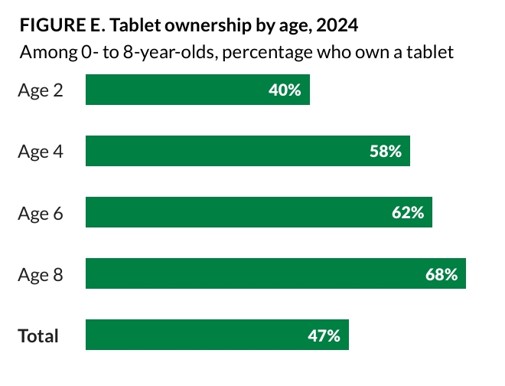
By 2 years old, 4 in 10 children have their own tablet (40%), and by 4 years old, more than half of children (58%) do. Overall, 47% of children under age 8 have their own tablet device.
Reference:
Mann, S., Calvin, A., Lenhart, A., and Robb, M.B. (2025). The Common Sense census: Media use by kids zero to eight, 2025. San Francisco, CA: Common Sense Media.
Young children learn best from real-world interactions. Heavy solo screen use can affect their developing language and social skills, depending on how many hours a day they spend on digital media and how adults use screens to calm or entertain them.
More concerns around misuse of digital media in young children:
In a study published in Developmental Psychology, researchers at UC Irvine found that using digital devices to calm or distract very young children was linked to increased behavior problems over time – and, for mothers, higher levels of parenting stress.
“Digital devices are incredibly effective at capturing children’s attention, especially when they are upset or bored, but when devices are used to calm or distract children, they may displace opportunities for children to develop self-regulation skills – skills that are critical for long-term social and emotional development.” ~ Stephanie M. Reich (excerpted from Parental reliance on digital devices to calm youngsters is linked to behavior problems – UC Irvine News)
Rapidly changing video content and highly stimulating media can be challenging to young children’s sustained attention and self-regulation.
Parents see the harm directly when kids can’t sleep.
NOTE: The U.S. Surgeon General’s Advisory: The Harms of Screen Use | HHS.gov
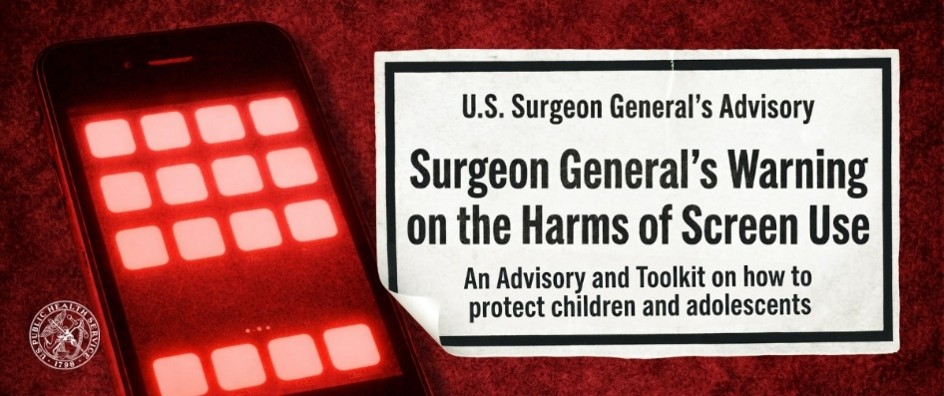
Sleep disruption is a key concern highlighted in the Surgeon General’s Advisory:
Promote Balanced Media Use
It is the quality of digital media that matters more than the number of minutes alone. High-quality educational content, video chatting with relatives, and co-viewing with caregivers can provide learning and social benefits.
Story time is important for brain development, even for babies who do not talk yet. When we read picture books with children, they are connecting the words we say to the pictures on the page and to the things in their world. All of those connections are brain connections!
See: Read It Again! Benefits of Reading to Young Children | HeadStart.gov and The Magic of Reading: Celebrating Book Lovers Day in Early Childhood Education – The Pennsylvania Key

Look for these qualities when evaluating Digital Apps:
Monitor Young Children Chatbot Interactions
Until AI product developers are clearer about labeling what the product is and what it provides, parents and caregivers should take care to guide children to understand AI tools and their limitations as social partners. Monitor the information provided by the chatbot and rephrase or supplement it based on the child’s needs
Parents and caregivers should evaluate these technologies carefully:
Model Healthy Screen Habits
It may be hard to keep phones out of sight completely, especially since phones are used by families to take photos and videos of their children. But carving out some boundaries to promote technology use in a healthy way is important.
See: Parents of Young Children: Why Your Screen Time Matters, Too – HealthyChildren.org)
Tips for Parenting Around Media Use in Early Childhood
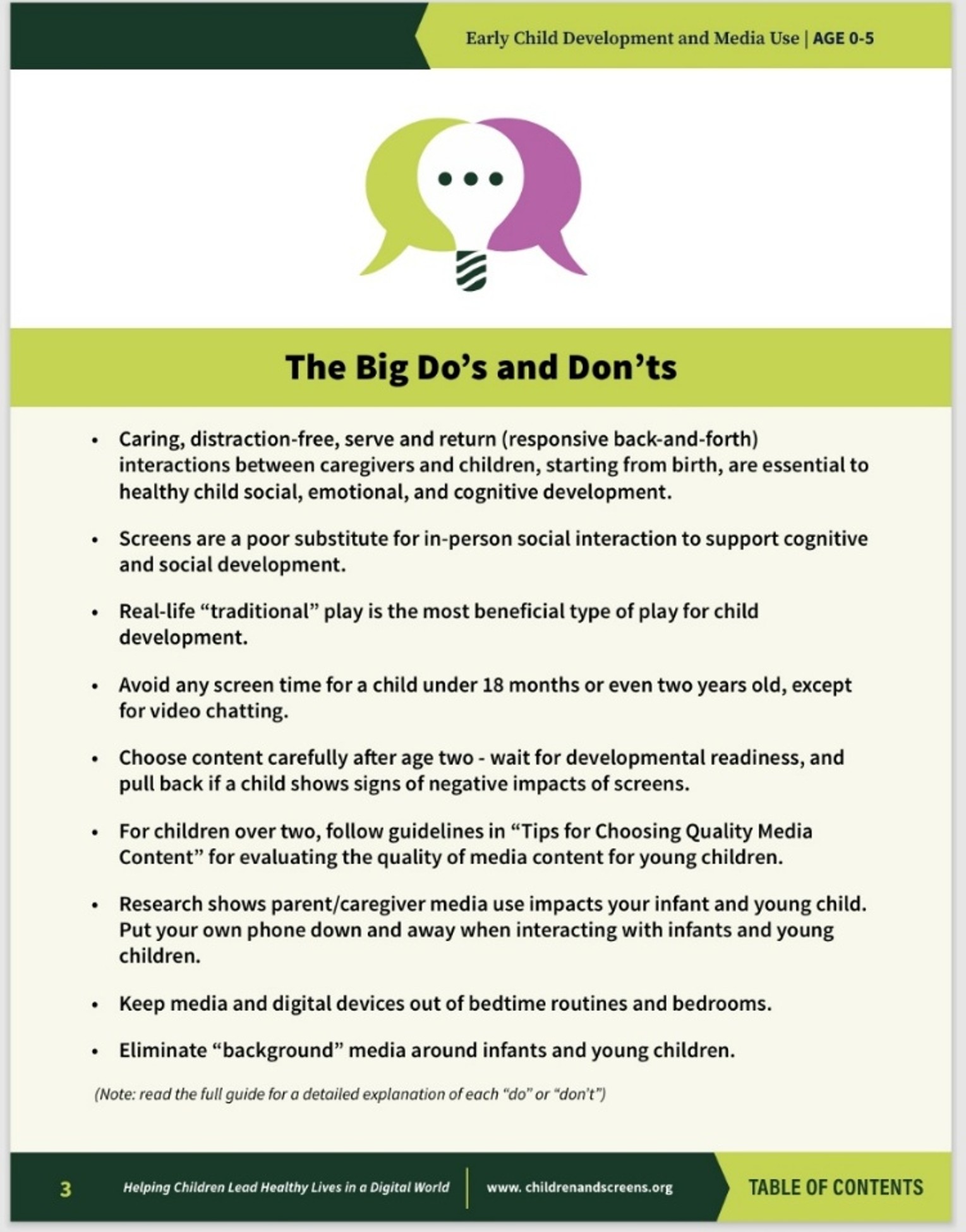
Check out The Big Do’s and Don’ts posted below, from Home – Children and Screens
American Academy of Pediatrics: Center of Excellence on Social Media and Youth Mental Health
Institute of Digital Media and Child Development: Home – Children and Screens
The Common Sense Census: Media Use by Kids Zero to Eight
The Office of the U.S. Surgeon General: Office of the Surgeon General (OSG) | HHS.gov
Mann, S., Calvin, A., Lenhart, A., and Robb, M.B. (2025). The Common Sense census: Media use by kids zero to eight, 2025. San Francisco, CA: Common Sense Media.
Munzer T, Parga-Belinkie J, Milkovich LM, et al; American Academy of Pediatrics, Council on Communications and Media. Digital Ecosystems, Children, and Adolescents: Policy Statement. Pediatrics. 2026;157(2): e2025075320. https://doi.org/10.1542/peds.2025-075320
Reich, S. M., Dore, R., Krager, A., Chen, Y. A., Mayfield, K. T., Franza, D., & Cabrera, N. (2026). Bidirectional relationships of parenting stress, media use for behavior management, and children’s behavior problems from 9 to 30 months. Developmental Psychology. Advance online publication. https://doi.org/10.1037/dev0002164
Surgeon General’s Warning on the Harms of Screen Use: An Advisory and Toolkit on How to Protect Children and Adolescents. https://www.surgeongeneral.gov
Disclaimer: This is the most updated information at release time. The information in Health Trends is not a Pennsylvania regulatory requirement for early childhood providers. Pennsylvania early childhood providers with regulatory requirements should contact their Cert rep or the Bureau of Certification.