 Created in 2007 by the Pennsylvania Office of Child Development and Early Learning (OCDEL), The Pennsylvania Key implements the work and supports the policies developed and managed by OCDEL. Learn More. >
Created in 2007 by the Pennsylvania Office of Child Development and Early Learning (OCDEL), The Pennsylvania Key implements the work and supports the policies developed and managed by OCDEL. Learn More. >
Created in 2007 by the Pennsylvania Office of Child Development and Early Learning (OCDEL), The Pennsylvania Key implements the work and supports the policies developed and managed by OCDEL. Learn More. >Children miss about 34 million school hours annually due to acute dental problems and unplanned dental care.
Tooth decay is more common than asthma.
Children from families with low incomes have more untreated cavities due to:
Sadly, these patterns have remained the same since they were first reported over 25 years ago (2000 Oral Health in America: A Report of the Surgeon General.)
Children with tooth decay suffer from difficulty eating, poor nutrition, delayed physical development, and poor self-image and socialization. Although largely preventable, if untreated, tooth decay leads to pain, inflammation, and the spread of infection to bone and soft tissue. Untreated cavities can cause brain abscesses, requiring hospitalization.
Both children and adults have died from untreated dental disease. (See Tragic Results When Dental Care Is Out Of Reach | FRONTLINE | PBS | Official Site | Documentary Series)
Health and housing security are closely intertwined
Celebrate National Children’s Dental Health Month:

Raise awareness about the importance of dental health in February and every month!
Start Healthy Habits Early (See Good Oral Health Starts Early: AAP Policy Explained – HealthyChildren.org)
Promote healthy tooth behaviors for babies:
Promote nutrition and oral hygiene habits for preschool children:
Caregivers: Rethink Your Drink!
Many popular drinks contain sugar and acid. Sugar, acids, and artificial sweeteners can weaken your teeth. How often you drink them matters to your teeth and smile.
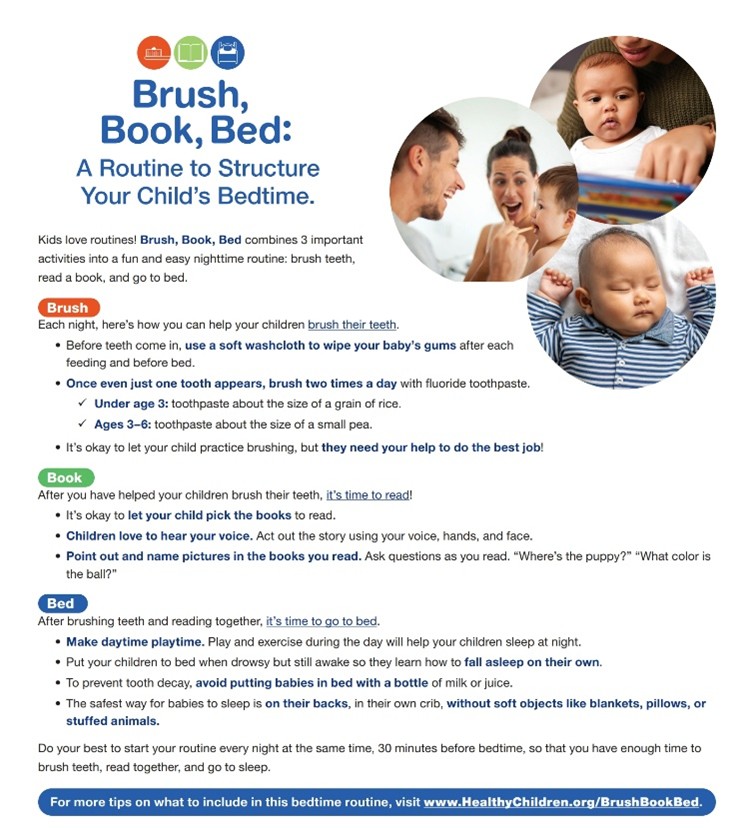
Establish healthy bedtime rituals:

Access Preventive Dental Care
Maintain regular well-child visits:
Medical providers can perform oral health screening to detect signs of dental decay and apply fluoride varnish to the primary (baby) teeth of infants and children at every visit.
“First Dental Visit by the First Birthday”
The American Academy of Pediatric Dentistry, American Dental Association, and the American Academy of Pediatrics all agree that children should have their first dental visit by their 1st birthday or within 6 months of their first tooth eruption, whichever comes first.
American Academy of Pediatrics, Healthy Children:
Listing of oral health resources for families
American Academy of Pediatric Dentistry (AAPD):
American Dental Association (ADA):
Free materials to celebrate and promote children’s dental health, not only during the month of February, but all year long
Centers for Disease Control and Prevention (CDC):
Oral Health Facts | Oral Health | CDC
Early Childhood Education Linkage System (ECELS):
Information and resources on dental care, finding a dentist, toothbrushing, and more
Healthy Teeth, Healthy Children (HTHC) – PA Chapter American Academy of Pediatrics
Office of Head Start
PA Coalition for Oral Health (PCOH):
Free materials relating to water fluoridation, tooth decay prevention and more
PA Promise for Children:
School Hours Lost Due to Acute/Unplanned Dental Care. American Academy of Pediatric Dentistry (AAPD)
2024 Oral Health Surveillance Report: Selected Findings Centers for Disease Control and Prevention
Oral Health Surveillance Report: Dental Caries, Tooth Retention, and Edentulism, United States, 2017–March 2020. Centers for Disease Control and Prevention. U.S. Dept of Health and Human Services; 2024.
Oral Health in America Executive Summary National Institutes of Health. 2021.
Does oral health influence school performance and school attendance? A systematic review and meta-analysis. International Journal of Paediatric Dentistry. 26 October 2018.
If We Care About Learning, We Must Care About Kids’ Oral Health. Paula Izvernari. LA School Report. January 20, 2026.
Maintaining and Improving the Oral Health of Young Children. Pediatrics (2023) 151 (1): e2022060417.
Oral health in America: A report of the Surgeon General U.S. Department of Health and Human Services. 2000.
Disclaimer: This is the most updated information at release time. The information in Health Trends is not a Pennsylvania regulatory requirement for early childhood providers. Pennsylvania early childhood providers with regulatory requirements should contact their Cert rep or the Bureau of Certification.