
Kitty Syster
Serving fluid milk is an important component of the CACFP (Child and Adult Care Food Program) guidelines. It must be served at breakfast, lunch and dinner and can be one of the two components you choose to serve at snack for all children who are over 12 months of age. Not everyone is able to drink dairy based milk, and others prefer not to. So how do you know what is an acceptable substitute for milk?
Non-dairy beverages may be substituted for cow’s milk, but they must be equivalent in nutritional value. The CACFP provides the nutritional requirements that must be met for a product to be considered equivalent. The chart below shows the nutritional values per cup needed to meet the CACFP guidelines.
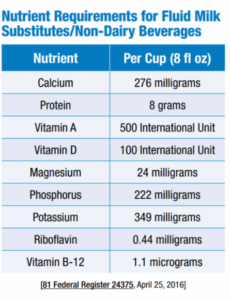
*Conversions for Vitamin A and D
Vitamin A 5,000 International Units (IU) 900 micrograms RAE5 (mcg) (500 IU equals 90mcg)
Vitamin D 400 International Units (IU) 20 micrograms (mcg) (100 IU equals 5mcg)
*Iron-fortified formula may be served to children between the ages of 12 months and 13 months to help with the transition to whole milk
*Breastmilk is allowed at any age if the CACFP
*Information provided from the www.fda.gov
Let’s practice reading a few labels to see if the products below meet the requirements:
Product 1:
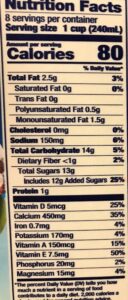
Does it meet the requirement? | |
|---|---|
Calcium | Yes |
Protein | No |
Vitamin A | Yes |
Vitamin D | Yes |
Magnesium | No |
Product 2: Phosphorus | No |
|---|---|
Potassium | No |
Riboflavin | Unknown (no) |
Vitamin B-12 | Unknown (no) |

Does it meet the requirement? | |
|---|---|
Calcium | Yes |
Protein | Yes |
Vitamin A | Yes |
Vitamin D | No |
Magnesium | No |
Phosphorus | Yes |
Potassium | Yes |
Riboflavin | Yes |
Vitamin B-12 | No |
Neither example meet the requirements. It is always best practice to read the labels carefully on all items you plan to use for CACFP reimbursement.